
Original price was: $328.00.$99.99Current price is: $99.99.
- The best quality products, always.
- Quality You Can Count On
- Peace of Mind with Every Purchase
- Uncompromising quality, every time.

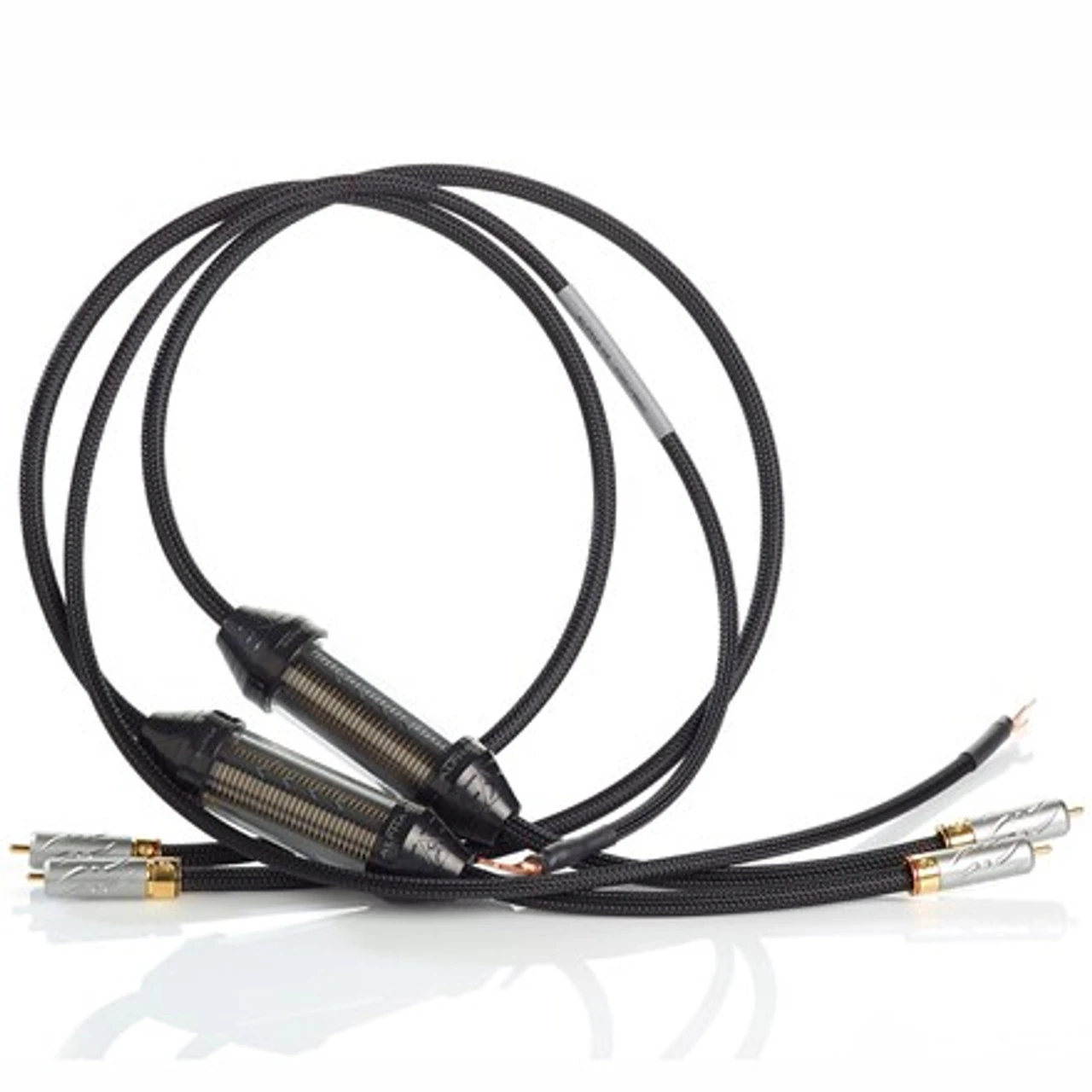
Maintain Original Signal Integrity and Reduce Ruinous Distortion Between Your Turntable and Phonostage with Shunyata Alpha v2 Phono Interconnects: Include TAP Devices
A set of phono interconnects that not only pass the crucial analog signal from your turntable to the phonostage but simultaneously reduce distortion? The fantasy becomes reality with Shunyata’s Alpha v2 phono interconnects, which provide reference performance and incorporate the company’s patented Zitron technology to lower dielectric noise and preserve signal integrity. Comprised of Ohno Continuous Cast Copper and VTX hollow-core conductors with fluorocarbon dielectrics, Alpha v2 comes with a completely isolated ground wire and a TAP device on each cable. Offering the ultimate in immediate out-of-the-box readiness, Alpha v2 also benefits from Shunyata’s Kinetic Phase Inversion Process (KPIP) – a pioneering conditioning method that eliminates the need for time-consuming burn-in and elevates the overall fidelity of your system. This is one serious – and seriously great – analog link. 100% Music Direct Guaranteed.
ZiTRON Technology
The insulation that protects wire can create a ghost-like signal that subtly burrs the source audio signal. The scientific term for this is: dielectric absorption and re-radiation. ZiTRON is a technology developed by Shunyata Research that prevents this type of signal cable micro-distortion. It requires a special type of conductor that has two signal paths. An electric-field compensation circuit creates a contra-signal that prevents the insulation from developing a charge. ZiTRON cables preserve the integrity of the source signal even when using very long cable runs are required.
Transverse Axial Polarizer (TAP)
Transverse Axial Polarizer is a device that interacts with the electromagnetic field generated by the signal traveling along the signal cable. TAP affects the behavior of the electromagnetic wave that surrounds the signal cable. In effect, the TAP blocks longitudinal-oriented waves while allowing transverse-oriented waves. The effect in sonic terms is like using polarized sunglasses to reduce reflected sunlight. Correcting polarization micro-distortion reduces what some call sonic glare.
ArNi Wire
ArNi wire was created by Shunyata Research designed to be the finest quality wire available. It begins with the highest purity of copper available – OFE C101, SPC or Ohno (single crystal). Fluorocarbon dielectrics, usually only found in in the aerospace applications have special electrical characteristics including extremely low dielectric absorption, high dielectric strength and exceptional heat resistance. When used in digital wiring it significantly reduces transient energy storage and release which affects phase noise performance.
VTX Conductors
Shunyata Research’s exclusive VTX conductors have virtual tube geometry. The core of the conductor is completely hollow minimizing skin effects and random eddy currents. They are produced using OFE Alloy C0101 – the highest grade of copper with a minimum 99.99% purity and a conductivity rating of 101% IACS.
Ohno Wire
Ohno wire, also called PCOCC was invented in 1986 by professor Atsumi Ohno of the Chiba Institute of Technology in Japan. Copper wire is created by an extrusion process that pulls a rod of cold copper through a small orifice which creates multiple crystalline boundaries. By contrast, Ohno wire is made by a process using heated molds that cast a wire to form a single crystalline structure. Ohno wire is well known for its exceptionally pure, grain-free sonic qualities.
Phono Ground Wire
Just as the quality of the phono signal cable can affect turntable performance, so to can the phono ground wire. The phono cable ground wire should not be an afterthought. It should be complete separate from the phono signal cable, not bonded to it. This isolates the ground wire from any captive reactance to the signal wires. Shunyata Research phono ground wires are made with VTX and VTX-Ag depending upon the model and are made from our exclusive ArNi conductors.
KPIP
Kinetic Phase Inversion Processing was developed by Caelin Gabriel after years of research into the underlying causes of various effects such as burn-in, wire directionality and the effects of cryogenic treatment. He discovered that there was an underlying core principle that burn-in and cryogenics only partially addressed. Once the governing principle was understood it became possible to create a processor that reduces the need for long burn-in periods and eliminates the effects of cryogenic treatment. Four-days of continuous KPIP processing dramatically reduces the sonic ups and downs associated with burn-in, delivering a relaxed and natural presentation.
| Select Option | RCA, 1.0m, RCA, 1.5m, RCA, 2.0m |
|---|
Be the first to review “Shunyata – Alpha V2 Phono Interconnects”
Related products
Headphones

Headphone Amps

Headphone Amps
Headphones

Headphone Amps
Reviews
There are no reviews yet.